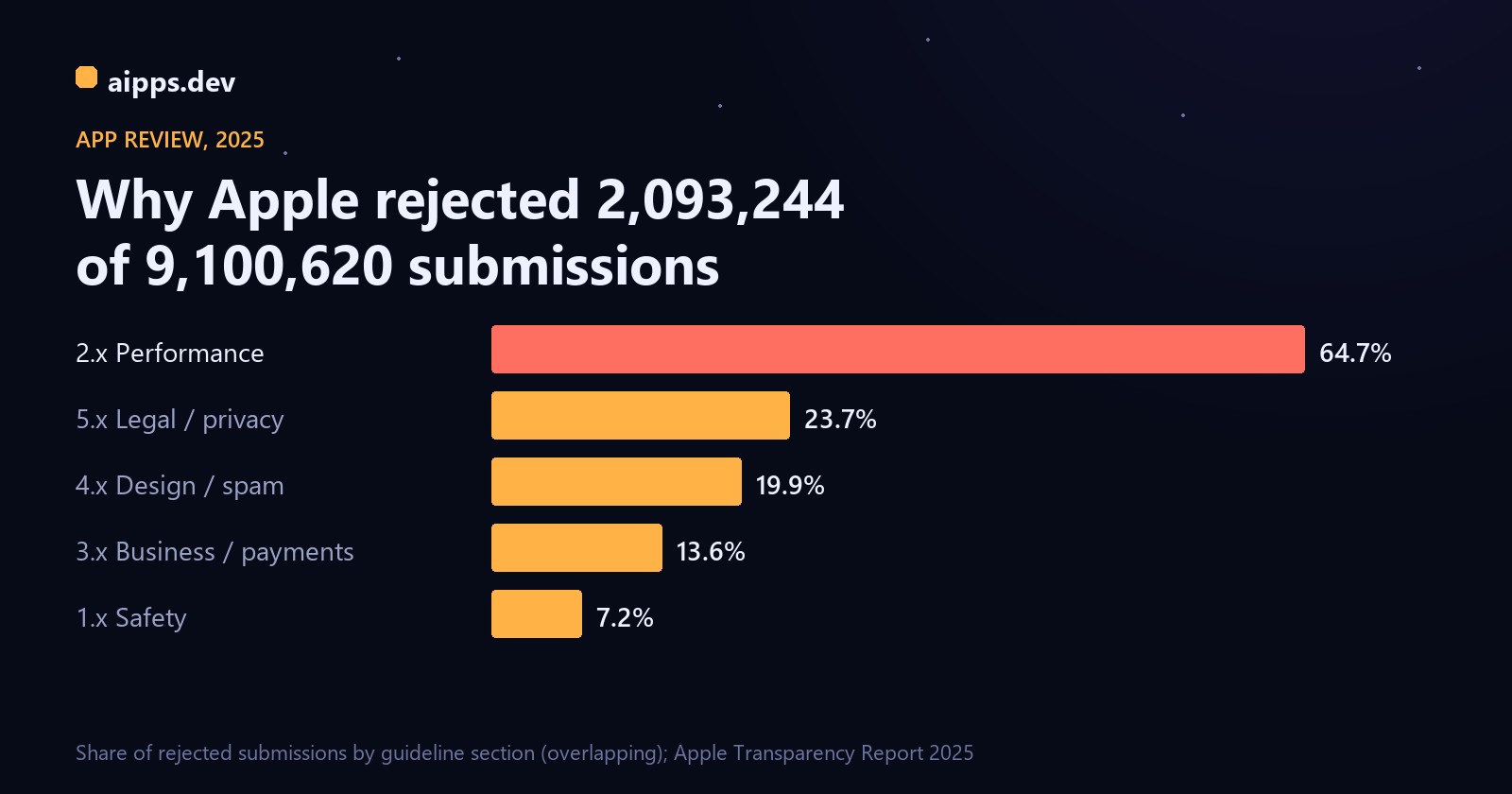
Bar chart: Apple App Store rejections in 2025 by guideline section, as a share of the 2,093,244 rejected submissions. Performance (2.x, which includes 2.1 App Completeness) 64.7%, Legal (5.x, privacy) 23.7%, Design (4.x, copycats and spam) 19.9%, Business (3.x, payments) 13.6%, Safety (1.x) 7.2%. One submission can be rejected under several sections. Source: Apple App Store Transparency Report 2025.

Apple reviewed 9,100,620 app submissions in 2025 and rejected 2,093,244 of them: 23.0%, or roughly one in four. Google doesn't publish a rejection rate, but it says it stopped more than 1.75 million policy-violating apps from being published on Google Play in the same year. Those are big numbers, and the useful part is underneath them: which rules the rejections fall under, how that has moved since 2022, and what that tells a release team to check before pressing Submit.

Everything below comes from the two stores' own reports: Apple's App Store Transparency Reports for 2022 to 2025 (the 2025 report went up on 20 May 2026), Apple's fraud-prevention newsroom posts, its App Review page, and Google's yearly Play safety posts (the 2025 one is dated 19 February 2026). Where a figure is our own division of theirs, we say so. We read every source on 1 November 2026.

Apple: four years of submissions and rejections

text
                                  2022        2023        2024        2025
Submissions reviewed         6,101,913   6,892,500   7,771,599   9,100,620
Submissions rejected         1,679,694   1,763,812   1,931,400   2,093,244
Rejection rate (ours)           27.53%      25.59%      24.85%      23.00%
Approved after a rejection     253,466     277,923     295,109     387,087
Apps removed from the store    186,195     116,117      82,509     166,899
Developer accounts terminated        -     117,843     146,747     193,035
Fraud prevented (US$)                -       1.84 B      2.02 B      2.23 B

Source: Apple App Store Transparency Reports 2022-2025 (published May each following year).
Rate = rejected / reviewed, our arithmetic.

Two things stand out. Volume is up 49% in three years (6.1 million to 9.1 million submissions) while rejections grew only 25%, so the rejection rate has fallen every year, from 27.5% to 23.0%. And Apple doesn't count apps here: every new version and every resubmission after a rejection is a submission, and Apple notes that an app may go to App Review several times before it is approved. Apple's 2025 newsroom post splits the 2 million+ rejections into more than 1.2 million for new apps and nearly 800,000 for updates.

The 'approved after rejection' line is the reassuring one. In 2025 Apple counted 387,087 submissions approved after an earlier rejection, which is 18.5% of the rejected total, up from 15.3% in 2024. A rejection is usually a round trip, not the end of the app.

Why Apple rejects: the guideline sections

Apple's reports break rejections down by the five sections of the App Review Guidelines, not by individual guideline. A submission can break several rules at once, so in 2025 the sections add up to 2,704,747 rejection reasons for 2,093,244 rejected submissions: 1.29 reasons per rejection on average (1.19 in 2022).

text
Section (what it covers)                 2025 rejections  % of rejected  % of all submitted
2.x Performance (2.1 completeness,             1,354,418         64.7%             14.88%
    2.3 accurate metadata, 2.5 software)
5.x Legal (5.1 privacy and data,                 495,673         23.7%              5.45%
    5.2 intellectual property)
4.x Design (4.1 copycats, 4.2 minimum            415,532         19.9%              4.57%
    functionality, 4.3 spam)
3.x Business (3.1 in-app purchase,               283,820         13.6%              3.12%
    subscriptions)
1.x Safety (objectionable content, user          151,159          7.2%              1.66%
    generated content, kids)
Other                                              4,145          0.2%              0.05%

Source: Apple App Store Transparency Report 2025. Percentages are ours; columns overlap
because one submission can be rejected under more than one section.

Performance is the giant: almost two out of three rejected submissions failed something in section 2, and about one in seven of all submissions (14.9%). Section 2 is where Apple's one per-guideline statistic lives. Its App Review page says:

In practice 2.1 means: the app crashed or hung on the reviewer's device, a button or link went nowhere, a screen still had lorem ipsum or a 'coming soon' tab, or the reviewer couldn't get past a login because no demo account (or a broken one) was given in the review notes. None of those need a policy expert to fix. They need someone to install the exact build you upload and walk through it on a clean device.

How the mix moved from 2022 to 2025

text
Share of rejected submissions     2022     2023     2024     2025
2.x Performance                  60.6%    64.2%    64.0%    64.7%
5.x Legal                        26.3%    23.9%    23.1%    23.7%
4.x Design                       12.6%    16.8%    19.6%    19.9%
3.x Business                      9.1%    10.9%    10.9%    13.6%
1.x Safety                        5.5%     5.9%     6.0%     7.2%
Other                             4.7%     2.3%     1.2%     0.2%

Our arithmetic from Apple's section counts / rejected total for each year.

Design is the fastest climber: from 212,464 rejections in 2022 to 415,532 in 2025, nearly double, as Apple pushes harder on copycats, thin apps and spam. Apple's 2025 fraud post puts more than 371,000 rejections down to copying, spam or misleading users, up from 320,000 in 2024 and 248,000 in 2023. If you publish several near-identical apps (one per city, one per client, a white-label template), this is the section that catches you. Business grew 35% in a year (209,845 to 283,820), which tracks with more apps selling subscriptions and digital goods.

Privacy is the other number to know. Apple's 2025 fraud post says more than 443,000 submissions were rejected for privacy violations (400,000 in 2024, 375,000 in 2023). That is a slice of the Legal section (495,673), and the usual causes are missing or broken privacy policy links, permission prompts that don't say why, data collection that doesn't match the privacy label, and required-reason APIs or SDK privacy manifests left out of the build.

Removals are a different list

Apps already on the store get removed for different reasons. The 2025 report lists 166,899 removals, led by fraud (90,608 under the Developer Program License Agreement's fraud clause) and a cleanup of outdated apps under guideline 4.0 Design (72,271). Apple's supplemental data gives per-guideline counts for removals only, and the familiar review guidelines are small there: 4.3 spam 418, 4.1 copycats 279, 2.3.1 hidden features 107, 2.1 completeness 41, 5.1.1 data collection 19. Hidden features matter more in review than in removals: Apple's newsroom post counts more than 22,000 rejections for hidden or undocumented features in 2025 (43,000+ in 2024). Appeals rarely win removals back: 26,305 removal appeals in 2025 led to 423 restorations, 1.6%.

Google Play: what Google publishes

Google gives totals for what it blocked, not a submission count, so there is no Play rejection rate to compare with Apple's. These are the figures from its yearly safety posts:

text
                                              2023        2024        2025
Policy-violating apps stopped from          2.28 M      2.36 M     1.75 M+
  being published
Developer accounts banned                     333 K      158 K+       80 K+
Apps stopped from excessive access to     ~200 K (a)     1.3 M      255 K+
  sensitive data or permissions
New malicious apps found outside Play          5 M+       13 M+       27 M+
Apps Play Protect scans per day                   -      200 B+      350 B+

(a) 2023: "almost 200K app submissions" rejected or remediated over sensitive permissions.
Sources: Google Security blog, 29 Apr 2024; Google blog, 29 Jan 2025 and 19 Feb 2026.

Every blocked count fell in 2025, and Google doesn't break any of them down by policy. Still, the pattern for ordinary teams is clear from the one reason Google itemises every year: permissions and sensitive data. Asking for SMS, call log, all-files access, background location, exact alarms or the accessibility service without a core use and a matching declaration in Play Console is the fastest way to a rejection. Google also says it runs more than 10,000 safety checks on every app it publishes.

Google publishes review time guidance rather than statistics: reviews of some apps, especially from new developer accounts, can take up to 7 days or longer (Play Console Help, answer 9859751). New personal developer accounts must also run a closed test with at least 12 testers for 14 days before they can apply for production; we covered that rule day by day in our article on Google Play's 12 testers rule.

What the numbers mean for your release plan

Apple says it reviews at least 50% of submissions in less than 24 hours and 90% in less than 48 hours. Put that next to a one-in-four rejection rate and you can size the buffer a release needs. A worked example for an iPhone release you want live by Friday:

text
Submit Monday 10:00
  First review, 90% case          by Wednesday 10:00   (48 h)
  If rejected (about 1 in 4):
    read, fix, rebuild, resubmit   + 4 to 8 h           (typical small fix)
    second review, 90% case        + 48 h
  Approved, worst usual case      Friday afternoon

Chance a submission is rejected at least once (2025):      23.0%
Chance it is rejected under section 2 (Performance):       14.9%
Days to plan for one rejection at the 90% review time:     about 4.5 (2 reviews + fix)

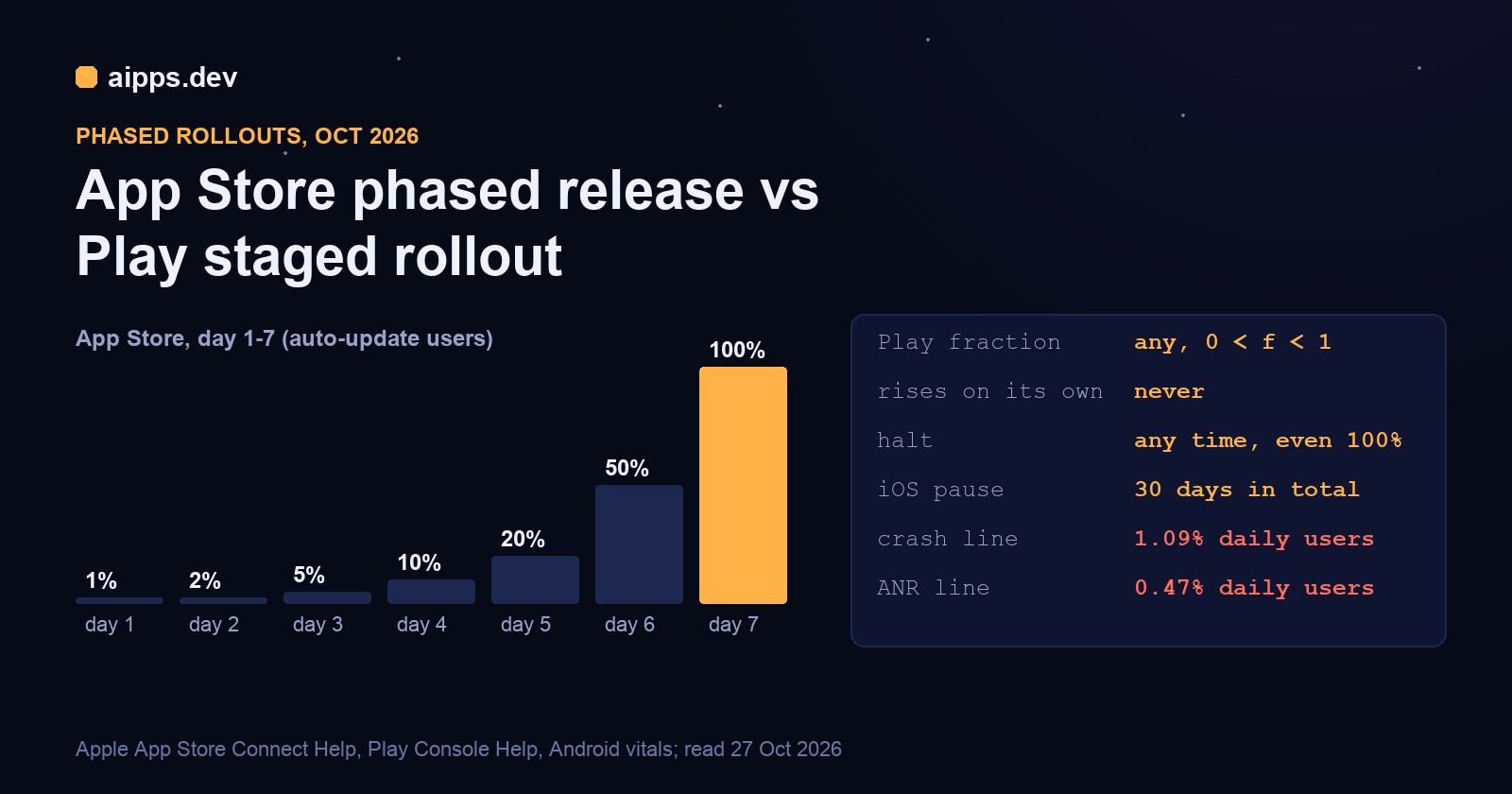
So 'submit two working days ahead' covers you only if you pass first time, which three in four submissions do. Submitting four to five working days before the date you've promised covers one rejection and fix at Apple's 90% review time. Phased release on iOS and staged rollout on Play then add their own days after approval; our article on phased rollouts has those numbers.

Before you submit: a checklist built from the numbers

Ordered by the share of rejections each item maps to. Apple's App Review page lists 14 common issues; every one is in here, with the guideline it falls under.

1. Performance, 64.7% of Apple rejections

text
[ ] Install the exact archive you will upload (not a debug build) on a real device or a clean
    simulator and go through every screen: no crash on launch, login, purchase or first run
[ ] No placeholder text or images, no "beta", "test" or "coming soon" tabs        (2.1)
[ ] Every link works: support URL, privacy policy, terms, in-app web links       (2.1)
[ ] Demo account in App Review notes, valid for weeks, with any 2FA or OTP explained;
    if a feature needs hardware, a QR code or a location, say how to try it      (2.1)
[ ] Screenshots show the app as it is in this build, on the right device sizes  (2.3)
[ ] Description, keywords and what's new match what the app actually does        (2.3)
[ ] No hidden or remotely enabled features the reviewer can't see               (2.3.1)

2. Legal and privacy, 23.7%

text
[ ] Privacy policy URL in App Store Connect and inside the app, and it loads   (5.1.1)
[ ] Every permission prompt says why in plain words (NS...UsageDescription)     (5.1.1)
[ ] Privacy nutrition label matches what the app and its SDKs collect           (5.1.2)
[ ] PrivacyInfo.xcprivacy present, required-reason APIs declared, SDK manifests
    included (missing ones show up as ITMS-91053 / ITMS-91061 emails)
[ ] Account creation? Then in-app account deletion too                          (5.1.1(v))
[ ] Logos, names and content you have the rights to                              (5.2)

3. Design, 19.9%

text
[ ] The app does something a website can't: not a wrapped site or a list of links  (4.2)
[ ] Not one of several near-identical apps from your account: use one app with
    options or settings instead of one per client or city                       (4.3)
[ ] Name, icon and screenshots don't imitate a well-known app                    (4.1)
[ ] Native-feeling UI that works on every device size you declare               (4.0)

4. Business, 13.6%

text
[ ] Digital goods and subscriptions sold in the app use In-App Purchase
    (or one of the regional or link-out exceptions you have actually set up)   (3.1.1)
[ ] Subscription price, period and what's included shown before purchase,
    plus restore purchases                                                     (3.1.2)
[ ] Right legal entity: an app for a bank, airline or clinic is published by
    that organisation's account, not the agency that built it                  (5.1.1(ix))

5. Google Play

text
[ ] Only the permissions the app's core feature needs; declarations filled in Play
    Console for SMS, call log, all-files access, background location, exact alarms
[ ] Data safety form matches the app and its SDKs
[ ] Target API level meets Play's current requirement for new apps and updates
[ ] Working demo login in App access, and a privacy policy link that loads
[ ] New personal account: 12+ testers opted in to a closed test for 14 days

Two of these are about the build file rather than the app: whether the archive you're uploading is signed with the profile you think it is, and whether it asks for what you expect. Our IPA and APK inspector shows version, profile type, permissions and target SDK from the file itself, and the new provisioning profile inspector lists the profile's type, expiry, devices, certificates and entitlements for the app and each extension. Both run in your browser and upload nothing.

Check the exact build before it goes to review: drop the .ipa into the provisioning profile inspector to see its profile type, expiry, certificates and entitlements for every target, and use the IPA and APK inspector for version, permissions and target SDK. Nothing is uploaded.

Open the profile inspector

Sources

text
Apple App Store Transparency Report 2025 (20 May 2026)
  https://www.apple.com/legal/app-store/transparency/2025/
Apple App Store Transparency Reports 2024, 2023, 2022 (PDF, May 2025 / 2024 / 2023)
  https://www.apple.com/legal/more-resources/docs/2024-App-Store-Transparency-Report.pdf
  https://www.apple.com/legal/more-resources/docs/2023-App-Store-Transparency-Report.pdf
  https://www.apple.com/legal/more-resources/docs/2022-App-Store-Transparency-Report.pdf
Apple Newsroom fraud posts (20 May 2026, 27 May 2025, 14 May 2024)
  https://www.apple.com/newsroom/2026/05/the-app-store-stopped-over-2-point-2-billion-usd-in-fraudulent-transactions-in-2025/
Apple App Review page (review times, guideline 2.1, common issues; read 1 Nov 2026)
  https://developer.apple.com/distribute/app-review/
Google: keeping Google Play safe in 2025 (19 Feb 2026), 2024 (29 Jan 2025)
  https://blog.google/security/keeping-google-play-android-app-ecosystem-safe-2025/
  https://blog.google/security/how-we-kept-google-play-android-app-ecosystem-safe-2024/
Google Security blog: bad apps and bad actors in 2023 (29 Apr 2024)
  https://security.googleblog.com/2024/04/how-we-fought-bad-apps-and-bad-actors-in-2023.html
Play Console Help: review times (answer 9859751)
  https://support.google.com/googleplay/android-developer/answer/9859751

Related on aipps.dev: Privacy manifests for React Native apps (https://aipps.dev/articles/react-native-privacy-manifest-required-reason-api-itms-91053), Google Play's 12 testers for 14 days rule (https://aipps.dev/articles/google-play-12-testers-14-days-closed-test-production-access) and phased rollouts on both stores (https://aipps.dev/articles/app-store-phased-release-vs-play-staged-rollout-percentages).