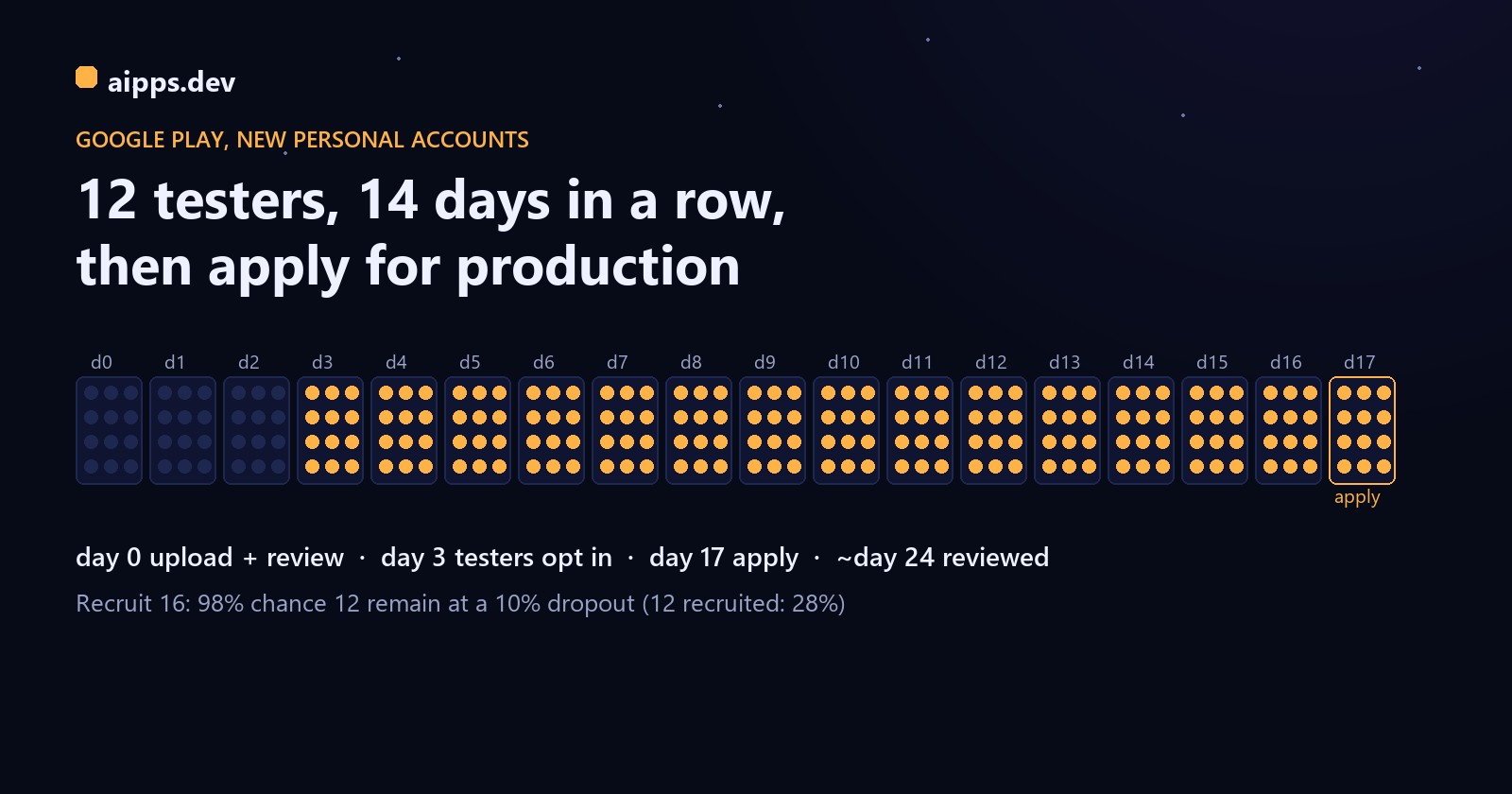
If you opened a personal Google Play developer account after 13 November 2023, the Production track in Play Console is greyed out when you arrive. It stays that way until you've run a closed test with at least 12 testers who have been opted in, without a break, for the 14 days before you apply. Then Google reviews the application, which it says usually takes seven days or less. For a first Android app that is three weeks between "the build is ready" and "anyone can install it from Play", and more if a tester drops out.
This article is the rule as Google's Play Console Help states it (answer 14151465, read 23 October 2026), the arithmetic of how many testers to recruit, and a day-by-day plan.
Who the rule applies to
The threshold was 20 testers when the rule launched; Play Console started showing 12 in December 2024. The 14 days never changed. If you are about to create an account and you are a company, an organization account skips the rule entirely, at the cost of the D-U-N-S paperwork.
How Google counts a tester
Three details in Google's wording decide whether you can apply on day 14 or day 30:
So the count that matters is not "12 people said yes" but "12 people are still opted in today and have been since day X". Invites that were never accepted count for nothing, and a tester who leaves on day 13 costs you that tester completely.
How many testers to recruit
Assume each tester has the same chance of leaving the test during the two weeks. The chance that at least 12 are still in on day 14 is a binomial sum. We worked it out for a 10% and a 20% dropout rate:
Recruiting exactly 12 is the most common way to lose two weeks: even with a loyal group, the odds are worse than a coin flip. Sixteen covers a 10% dropout comfortably, and twenty covers almost anything short of a group that was never interested. Friends and colleagues on Android phones are the usual pool; tester-exchange communities exist, but Google's application asks how testers used the app, and twelve strangers who opened it once make that answer hard to write honestly.
The application questions
When the 14 days are up, the Dashboard shows "Apply for production". The form has three parts, and the answers are reviewed, so collect the material while the test runs rather than afterwards:
If Google decides the app needs more testing, closed testing simply continues; Google lists "fewer than 12 opted-in testers or insufficient tester engagement" as reasons. Shipping two or three closed-test builds during the window, each with a changelog line that answers a tester's feedback, gives you the "what you changed" answer for free.
A day-by-day plan
Day 17 is the best case with every tester opted in on day 3. In practice the last few testers opt in a day or two late, so day 19 or 20 is a more honest target for the application, and roughly four weeks from first upload to a public listing.
Getting the builds to testers without waiting on review
The closed test proves engagement to Google, but it's slow to iterate on: every new build goes through Play's processing, and testers update when Play gets round to it. For the quick fix-and-check loop inside those 14 days, many teams send the same build as a direct APK install as well: tester scans a QR code, the APK installs, and the closed-test build from Play catches up later. Both count; only the Play opt-in counts for the rule.
Every aipps.dev build ends in an install page with a QR code, so testers can get today's APK in seconds while the Play closed test runs.
See aipps.devRelated: what iOS and Android builds cost on CI in 2026, and the 2026 store deadlines calendar: from 31 August 2026 that first Android release also has to target API level 36.
Sources: Play Console Help, "App testing requirements for new personal developer accounts" (answer 14151465): 13 November 2023 cut-off, 12 testers, 14 consecutive days, application questions, review usually seven days or less; read 23 October 2026. 20-to-12 change: Play Console prompt from 11 December 2024, reported by developers (forum.adalo.com) and Android Authority. Dropout table: our binomial calculation.