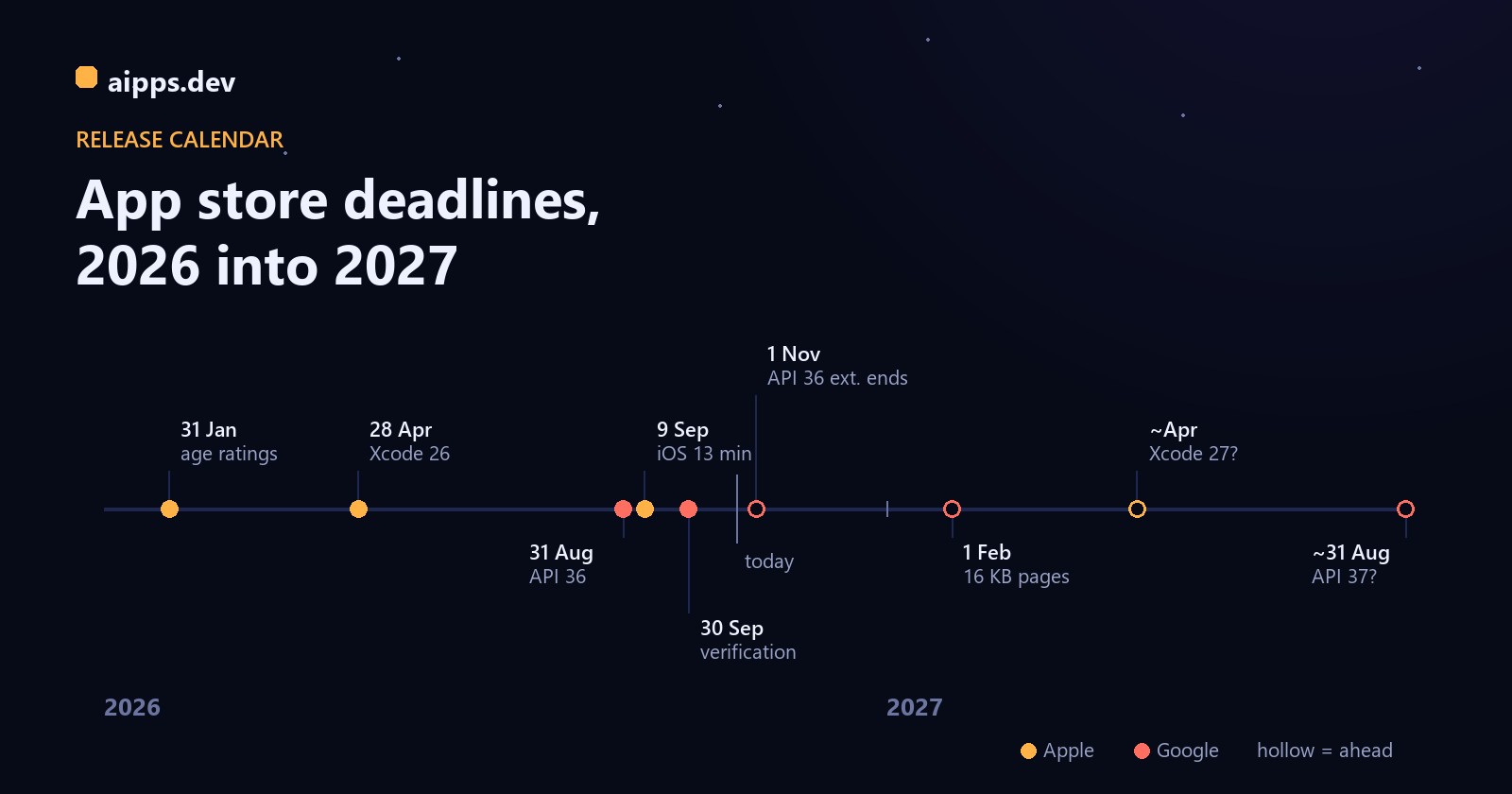
Release teams lose days to deadlines they knew about and forgot: an upload rejected with ITMS-90725 (built with an old SDK) because the build machine still had last year's Xcode, an update blocked in Play Console because the target API level slipped. Apple and Google publish every one of these dates in advance, on two pages most people only read when something breaks. Here they are on one calendar, as of 23 October 2026, with what each one means for a build pipeline and how many days are left.
The calendar
The last two rows are not announced yet; they follow a pattern both stores have kept for years. Apple has moved the required Xcode every spring: Xcode 15 from 29 April 2024, Xcode 16 from 24 April 2025, Xcode 26 from 28 April 2026, each about seven months after that Xcode shipped. Google has raised the target API level every 31 August, one level a year: API 34 in 2024, API 35 in 2025, API 36 in 2026. Plan for both and you will rarely be surprised.
Apple: what each date means for your builds
Xcode 26 since 28 April 2026
Every binary you upload, new app or update, must come out of Xcode 26 or later with the 26 SDKs. Apps already on the store keep working; it's the next upload that fails. For a pipeline this means: every build machine and CI image on Xcode 26, Expo projects on SDK 54 or later (Expo's EAS images for SDK 54 and 55 default to Xcode 26; it recommends upgrading older projects rather than forcing the new image), and native dependencies (CocoaPods, Swift packages) that compile with the Xcode 26 toolchain. Check the image you build on, not your laptop: hosted runners keep several Xcode versions installed and the default isn't always the newest.
iOS 13 minimum since 9 September 2026
Uploads must target iOS 13 or later. Most React Native and Flutter templates already set a far higher minimum (React Native has required iOS 15.1 since 0.76), so this mostly bites old native projects that never raised IPHONEOS_DEPLOYMENT_TARGET.
Age ratings since 31 January 2026
Apple replaced its age-rating system and asked every developer to answer the new questions in App Information. If an app was missed, its next update stalls in App Store Connect until someone answers them: worth checking on any app that hasn't shipped this year.
Google: what each date means for your builds
Target API 36 since 31 August 2026
New apps and updates must set targetSdkVersion 36. Separately, an existing app that targets API 34 or lower is hidden from new users on devices running a newer Android than it targets; it needs at least API 35 to stay visible to them. Extensions to 1 November 2026 were available through Play Console forms, so any app still running on one has nine days. Raising targetSdk is the easy line in build.gradle; the work is in the behaviour changes it switches on (Android 16's edge-to-edge and predictive back changes are the usual ones), which need a full test pass.
16 KB page sizes by 1 February 2027
Apps targeting API 35 or higher (that is every app being updated) whose native libraries are not linked for 16 KB pages can't release updates after 1 February 2027. React Native, Flutter and any app with an .so file is in scope. How to check, including a check that passes when it shouldn't: Android 16 KB page sizes: check your APK.
Developer verification since 30 September 2026
This one isn't about Play listings. Certified Android devices in Brazil, Indonesia, Singapore and Thailand now check that apps installed from participating stores (Google Play, HONOR, OPPO, Samsung Galaxy Store, Transsion Palm Store, vivo, Xiaomi GetApps) come from a verified developer, and Google says it will expand verification to all apps on certified devices globally in 2027. Teams that hand out APKs outside Play should register now. Students and hobbyists get limited distribution accounts: share an app with up to 20 devices without a government ID or registration fee. Installs through adb are not affected, so development and QA on cabled devices carry on as before.
A checklist for the next build
Put the first five in the pipeline itself rather than in someone's memory: a build step that fails on the wrong Xcode, a Gradle check on targetSdk, and an alignment check on the finished APK cost a few seconds per build and turn a store rejection into a red CI run on the day the change lands.
aipps.dev keeps its Mac mini and Android build machines on the toolchains these dates require, and every build ends in a QR install page for your testers.
See aipps.devRelated: what iOS and Android builds cost on CI in 2026, and for a first Android release, Google Play's 12 testers for 14 days rule.
Sources: Expo blog, App Store Connect minimum SDK 26; Apple Developer, Upcoming requirements (developer.apple.com/news/upcoming-requirements: 31 Jan 2026 age ratings, 28 Apr 2026 Xcode 26 SDK, 9 Sep 2026 iOS 13 minimum; earlier Xcode 15 and Xcode 16 dates); Android Developers, Target API level requirements (API 36 from 31 Aug 2026, extension to 1 Nov 2026, page updated 16 Oct 2026); Android Developers, Support 16 KB page sizes (1 Feb 2027); Android Developers, Android developer verification (Aug 2026 launch, 30 Sep 2026 enforcement, 2027 global, limited distribution 20 devices); store list and adb exception as reported by Malaysian Wireless and Android Authority, June 2026. All read 23 October 2026.